Amazon Finds
Top 7 Funny Gift Ideas People Will Laugh at and Secretly Want
Some gifts are polite. Candles. Mugs. Gift cards. Safe choices for people you barely know.
And then there are gifts people actually remember. The kind that make someone stop, laugh, and immediately ask, "Where did you even find this?"
Those are the good gifts. The slightly unhinged ones. The ones that feel unnecessary and somehow absolutely perfect.
Here are 7 funny gift ideas weird enough to be unforgettable.
#1 The Desk Organizer That Looks Like Someone Having a Very Honest Workday


Tape. Sticky notes. A pen. A tiny man on a toilet. Everything you need.
The modern desk organizer exists in a state of quiet denial. It is sleek, it is neutral, it is designed to project an image of a person who has their systems in order and their priorities aligned and their workspace optimized for maximum output. It holds your pens in a way that suggests competence. It keeps your cables tidy in a way that implies you are the kind of person who thinks about cables. It is, in every deliberate way, a small lie you tell yourself and everyone who walks past your desk about the true nature of your relationship with productivity. This desk organizer does not tell that lie. This desk organizer has looked at the lie, considered it carefully, and placed a tiny man on a toilet instead.
The design is fully committed to its premise and somehow also completely functional, which is the combination that elevates it from novelty to necessity. The tape dispenser sits in front of the figure, held in place and ready to use exactly as a tape dispenser should be. The tank behind him — the toilet tank, which is a sentence that belongs in a product description — opens to store sticky notes, keeping them accessible and contained in the way that sticky notes, left to their own devices, never manage to be. A pen slot keeps your most-used writing instrument upright and within reach. The entire system works. It works well. It was designed by someone who understood both office supply organization and the specific comedy of placing that organization inside a toilet scenario, and who saw no contradiction between those two things.
What this organizer does to the atmosphere of a desk is immediate and consistent. It gets noticed first — before the monitor, before the plant, before whatever motivational object you may have placed nearby in a more optimistic moment. Coworkers stop. They read it. They process it. Then comes the laugh, which is followed almost immediately by the admission, sometimes reluctant, sometimes enthusiastic, that they kind of want one. This is the cycle. It repeats with every new person who encounters it, because the toilet desk organizer sits in that precise sweet spot between absurd and relatable that makes something genuinely funny rather than just weird. Everyone understands the joke because everyone has had the kind of workday the joke is describing.
There is also something quietly philosophical about keeping this on your desk — a small, daily acknowledgment that productivity is rarely the elegant, optimized experience that desk accessories typically pretend it is. Most workdays are improvised. Most tasks take longer than they should. Most afternoons involve at least one moment where you are sitting very still, doing something that feels vaguely unproductive, and hoping it somehow contributes to the larger goal. The tiny man on the toilet understands this. He is not judging. He is, in fact, modeling the behavior — present, holding it together, managing the supplies, getting through the day one tape dispenser at a time. That is not failure. That is, on most days, exactly enough.
#2 The Bathroom Sign That Asks the Question Everyone Is Avoiding


Elegant. Direct. Asking for a friend.
Bathroom decor has, for a very long time, operated under a strict set of unspoken rules. The walls say things like relax or soak or breathe, accompanied by a sprig of eucalyptus or a watercolor wave that implies this room is a sanctuary, a place of peace, a small domestic spa where nothing uncomfortable or undignified ever occurs. The candles smell expensive. The hand towels are folded. The entire aesthetic is committed to a version of the bathroom that is aspirational rather than accurate — a room that exists in a parallel universe where people only ever enter to wash their hands and emerge glowing and refreshed, never for any of the other reasons people actually use a bathroom. This sign has no interest in that universe. This sign has a black cat on it and a direct question, and it would like an answer.
The sign is simple in the best possible way — a black cat, rendered with the specific expression of a creature that already knows the answer but is asking anyway, making direct and unwavering eye contact, accompanied by three words that cut through every pretense the bathroom decor industry has ever attempted to construct. Are you pooping? It does not soften the question. It does not frame it euphemistically or dress it up in language that makes it easier to process. It asks clearly, directly, and with the calm confidence of something that has been hanging on a wall long enough to have seen things and arrived at the conclusion that honesty is simply more interesting than a watercolor wave.
What makes it work as wall art — genuinely, repeatedly, every single time someone new encounters it — is the combination of the cat's expression and the question's delivery. The cat is not amused. The cat is not scandalized. The cat is simply asking, with the patient energy of a being that has transcended embarrassment entirely and would like you to consider doing the same. There is something almost liberating about that. The sign walks into the most private room in the house and acknowledges, without flinching, what that room is actually for. It validates the experience. It witnesses it. It does so with a black cat and minimal punctuation, which is, it turns out, exactly the right amount of ceremony for the occasion.
As a gift it is in a category of its own — the kind of thing that gets unwrapped, held up, read aloud, and then laughed at for longer than almost any other gift in the room. It is perfect for guest bathrooms, where it will be discovered by visitors who are already in a vulnerable position and therefore find it approximately three times funnier than they would anywhere else. It works in office restrooms, where it provides a moment of genuine human connection in an environment that rarely offers one. It works for anyone who has looked at the available options in bathroom wall art and felt, quietly but persistently, that none of them were being fully honest about the situation. This sign is being honest. The cat is asking. And somewhere, in a bathroom near you, someone is reading it and laughing alone, which is honestly one of the better things a piece of wall art can accomplish.
#3 The Enamel Pin That Summarizes Modern Problem Solving
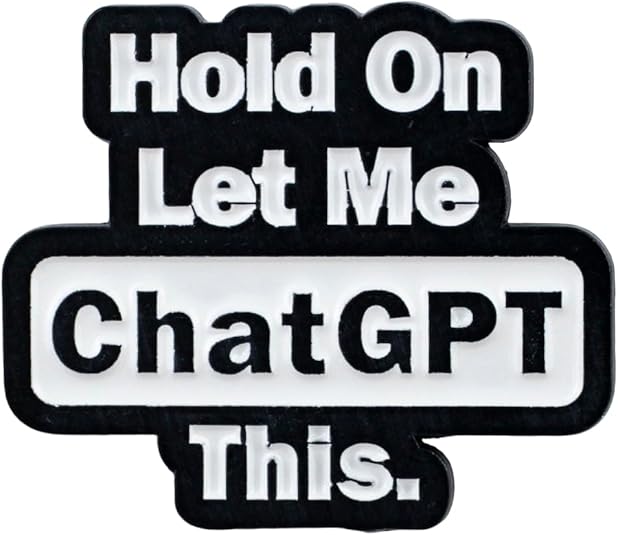

Not a joke. A lifestyle. A confession. A pin.
There was a period in recent human history — not that long ago, close enough to remember clearly — where encountering a problem meant thinking about it. You would sit with the question, maybe consult a book, maybe ask someone nearby who seemed like they might know, maybe work through the logic yourself until something clicked. This process had dignity. It had patience. It produced, occasionally, a genuine sense of accomplishment that came from having navigated uncertainty using nothing but your own reasoning and whatever information you had already accumulated in your brain. That period is not entirely over. It has simply been supplemented, in most practical situations, by opening a new tab, typing the problem in full, and waiting approximately four seconds for a response that is usually pretty good and occasionally a little wrong in ways that are difficult to detect immediately but that is a problem for later.
The pin says: Hold On, Let Me ChatGPT This. Five words that have, quietly and without any formal announcement, become one of the most accurate descriptions of modern intellectual life available. It does not say this with shame. It does not say it with pride, exactly, either — it says it with the calm, clear-eyed honesty of a person who has made peace with how things actually work now and sees no particular reason to pretend otherwise. You have a question. There is a tool. The tool is good. You are going to use the tool. This is the sequence. The pin acknowledges the sequence. The pin wears the sequence on your jacket, your bag, your lanyard, your shirt — wherever you choose to display it — so that the people around you understand immediately what kind of problem solver they are dealing with and can adjust their expectations accordingly.
What makes it resonate beyond the obvious joke is how broadly it applies. The programmer who uses it to debug code they could theoretically work through manually but why would they. The student who reaches for it before the textbook, not because the textbook is wrong but because the textbook takes longer. The office worker who pastes the confusing email into a chat window and asks for a summary before reading it themselves, which is a thing that is happening constantly and everyone knows it and nobody is admitting it out loud. The person who used it to write a message they were not sure how to phrase, or to explain a concept they mostly understood but not quite enough to explain, or to settle an argument at dinner that could have gone unresolved but felt important in the moment. The audience for this pin is, essentially, anyone with a Wi-Fi connection and a problem, which is most people, in most places, for most of the day.
As a gift it lands perfectly for anyone in tech, education, creative fields, or any profession that involves knowing things and occasionally not knowing things and needing a fast and reliable bridge between those two states. It is small enough to go anywhere, specific enough to feel personal, and honest enough to generate a genuine laugh from anyone who reads it and recognizes themselves in it — which, at this point in history, is nearly everyone. Some accessories make a statement about who you aspire to be. This one makes a statement about who you already are, how you already operate, and what you are almost certainly about to do the next time someone asks you a question you don't immediately know the answer to. The tab is already open. The cursor is blinking. Hold on.

#4 The Fish Slippers That Make Every Walk a Personal Decision

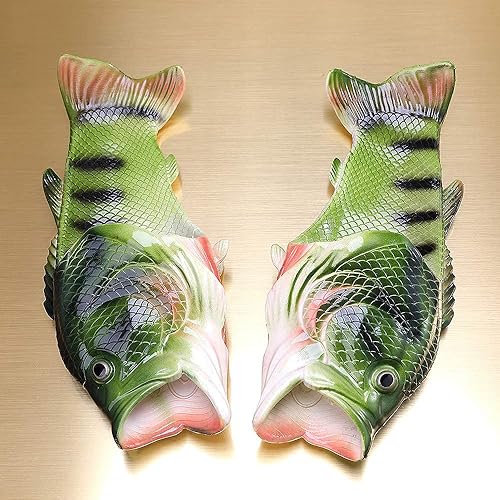
Comfortable. Committed. Impossible to ignore.
There is a moment, shortly after putting on the fish slippers for the first time, where you look down at your feet and are required to make a decision about who you are. Not in a dramatic, existential way — more in the quiet, specific way of realizing that the object currently on your feet has an opinion about your identity and is expressing it loudly on your behalf without having asked for permission. The fish are realistic. That is the detail that gets people. Not cartoon fish, not abstract fish-shaped foam — aggressively, specifically, anatomically committed fish, scaled and detailed and staring up at you from the floor with the blank, patient expression of creatures who have accepted their situation and are ready to take you wherever you need to go. You look at them. They look at nothing, because they are slippers. And then you take your first step, and the decision is made, and there is no going back.
Walking to the kitchen becomes an event. This sounds like an exaggeration and is not. The fish slippers do something to the quality of movement through a space — they introduce a presence, a kind of advance notice, that normal footwear simply does not provide. You hear yourself coming. Other people hear you coming. By the time you arrive at your destination, the fish have already preceded you into the room and established the tone of whatever interaction is about to happen. Houseguests look up from their phones. Family members stop mid-sentence. The question arrives reliably, every time, from every person who has not yet encountered the slippers: are those fish? And you confirm that yes, they are fish, and the conversation that follows is almost always better than the one that was happening before you walked in.
What elevates the fish slippers from novelty item to genuine daily footwear — and this is the part that surprises people most — is that they are actually comfortable. This is the dangerous part. A ridiculous slipper that is uncomfortable remains a joke, something worn once for a photograph and retired to the back of the closet where it belongs. A ridiculous slipper that is also genuinely pleasant to wear on your feet is something else entirely. It stops being a costume and starts being a choice, and then a habit, and then simply the thing you reach for without thinking when you get home and need something on your feet. The fish become normal. Your normal becomes fish. This is the progression, and it happens faster than anyone anticipates.
As a gift they occupy a rare category — the kind of thing that looks like a joke in the bag and turns out to be something the recipient actually uses, which is the highest possible outcome for any gift in the novelty space. They work for anyone who spends time at home, which is everyone, and for anyone who has ever looked at their existing slippers and found them adequate but uninspiring, which is most people if they are being honest. Life is full of objects that are practical but forgettable. The fish slippers are practical and completely impossible to forget — by you, by everyone who lives with you, and by every guest who walks through your door and encounters two realistic fish staring up at them from the floor with the calm, unblinking confidence of footwear that knows exactly what it is and has made peace with it entirely.
#5 The Back Scratcher That Solves Problems Like a Monster


A real problem. A tiny monster. A surprisingly complete solution.
The back itch is one of the great equalizers of human experience. It does not care about your age, your profession, your composure, or the meeting you are currently in. It arrives without warning, locates itself in the precise spot that is geometrically impossible to reach through any natural configuration of the human arm, and then simply waits — patient, specific, and completely immune to the various creative contortions you will attempt in the next thirty seconds before accepting that you cannot handle this alone. Every adult has been here. Every adult has done the doorframe lean, the pen-down-the-collar maneuver, the desperate shoulder blade shimmy that technically helps but not quite enough. It is undignified. It is universal. And it is, as of this product, solvable by a tiny monster perched at the end of an extendable back scratcher with the focused energy of a creature that was born for exactly this purpose.
The monster at the top is the detail that makes everything else work. A plain back scratcher is a tool — useful, forgettable, the kind of thing that lives in a drawer and gets found occasionally and used without ceremony. But a back scratcher with a small Godzilla-adjacent creature at the tip is an object with character, with presence, with a narrative. The monster is not decorating the back scratcher. The monster is the back scratcher, in every meaningful sense — it is the reason you pick it up, the reason you keep it somewhere visible rather than buried in a drawer, and the reason that reaching that impossible spot feels less like a mundane act of personal maintenance and more like deploying a specialist. You extend it. You reach the exact location. The monster handles the situation. Life becomes immediately and measurably better.
What the back scratcher understands, that most practical gifts do not, is that the experience of using a tool matters as much as the result it produces. Two back scratchers can reach the same spot and relieve the same itch — but only one of them does it with a tiny monster involved, and that distinction is not trivial. There is a specific satisfaction that comes from solving a problem with something that looks like it was designed for a more dramatic purpose. The monster brings energy to the task. It makes a mundane physical necessity feel like a small, private victory — you against the itch, and you brought reinforcements, and the reinforcements are extraordinary and slightly terrifying and exactly the right size for the job.
As a gift it follows the most reliable arc in the novelty category — the laugh first, the use second, the quiet conversion third. Someone unwraps it, holds it up, laughs at the monster, and files it mentally under funny gift I received once. Then the itch arrives, as it always does, at an inconvenient moment, and the back scratcher is the nearest thing, and they extend it, and it reaches the spot perfectly, and from that moment forward it is no longer a funny gift. It is simply the back scratcher. The one they reach for. The one that lives somewhere accessible rather than in a box. The monster has completed its mission, settled in, and made itself at home — which is, honestly, very on-brand for a tiny Godzilla with a job to do.
#6 The Fried Chicken Keychain That Causes Immediate Confusion


Your keys needed a statement piece. Hunger was not consulted.
The keychain has historically been a humble object. A functional loop of metal that keeps your keys together and occasionally tells people something small and manageable about who you are — a souvenir from a place you visited, a miniature of something you love, a letter or a charm or a small photograph. It is an accessory in the most literal sense: secondary, supportive, present but not demanding attention. This keychain is not that. This keychain is a aggressively detailed, shiny, golden, suspiciously realistic piece of fried chicken hanging from your keys like a snack that got lost on the way to lunch and decided to make the best of its situation. It demands attention. It receives attention. It has never once gone unnoticed by anyone within reasonable viewing distance, and it has no intention of starting now.
The detail is what makes it work and also what makes it slightly unnerving in the best possible way. A cartoonish chicken drumstick would be cute and forgettable — something you glance at, register as food-shaped, and move on from without incident. This is not that. The craftsmanship here is committed to a level of realism that the human brain is not entirely prepared to process in a keychain context. The golden-brown surface catches light the way actual fried chicken does. The texture suggests crispiness. The shape is specific and accurate and deeply familiar to anyone who has ever eaten a drumstick, which is most people, which means most people's brains do the same thing when they see it — they recognize food before they recognize object, and that half-second delay between wait, is that— and oh, it's a keychain is where all the magic lives.
The question arrives consistently, from strangers, from coworkers, from friends who have seen the keychain before and somehow still need to ask again: wait, is that chicken? And the answer is yes, in the way that matters — not edible, not real, but fully committed to the aesthetic of fried chicken in a way that makes the distinction feel almost beside the point. You pull out your keys at the checkout counter and the person behind you leans forward slightly. You set your bag down at a meeting and someone across the table does a quiet double take. You hand your keys to a valet and watch them look at the chicken for just a moment longer than is strictly necessary before deciding not to say anything, which is somehow funnier than if they had. The keychain creates these moments reliably, everywhere, for as long as you carry it.
As a gift it is one of the cleanest choices available for anyone who loves food, appreciates a good double take, or believes that the objects you carry with you daily should reflect something true and slightly chaotic about your personality. It is small enough to ship anywhere, affordable enough to include in any budget, and specific enough to feel like a considered choice rather than a generic one. Some keychains tell people where you've been. Some tell people what you love. This one tells people that you are the kind of person who attached fried chicken to your keys and thought that was a completely reasonable decision — which, for the right person, is the most accurate and endearing thing a keychain has ever communicated about its owner.
#7 The Bald Man's Comb That Finally Commits to Honesty


No teeth. No pretense. No hair required.
The gag gift has a long and complicated history of trying too hard. It arrives in novelty packaging, it makes a noise, it lights up, it does something unexpected when you press the button — it performs. And the performance is fine, usually. People laugh, the moment passes, the object gets set down and eventually finds its way to a drawer or a donation box or the back of a cabinet where novelty items go to be forgotten quietly and without ceremony. The Bald Man's Comb does none of this. It does not perform. It does not try to surprise you with hidden functionality or an unexpected twist. It shows up, it is exactly what it says it is, and in being exactly what it says it is with complete and total commitment, it becomes one of the funniest things you can hand to another person without saying a single word.
The comb has no teeth. This is the joke, and also the entire product, and also somehow enough — more than enough, in fact, because the simplicity of it is precisely what makes it land so cleanly. There is no setup required, no explanation needed, no moment where you have to clarify what you meant by it. The recipient picks it up, looks at it, registers the absence of teeth, and the joke completes itself instantly inside their brain with zero assistance from you. That self-completing quality is rare in comedy and rarer still in physical objects. Most jokes need delivery. This one needs only to exist in someone's hands for approximately two seconds, after which the reaction arrives on its own — a laugh that comes from somewhere genuine, followed almost always by the same four words: okay, that's actually good.
What makes the Bald Man's Comb stick in the memory long after other gifts have faded is how honestly it operates. It does not pretend to be useful. It does not dress itself up as something it isn't. It looks directly at the situation — the hairline that has been retreating for years, the scalp that has become a topic of gentle group discussion at family gatherings, the morning routine that has been significantly simplified by biology — and it acknowledges it, without cruelty, without meanness, with nothing but the specific warmth that comes from a joke that could only be made between people who know each other well enough to tell the truth. That is what separates a good gag gift from a great one. The great ones feel like affection delivered sideways.
The audience for this product is specific and enormous simultaneously — every dad who has been pretending not to notice, every brother whose head has become a running joke, every coworker whose hairline gets its own weather forecast at the office, every husband who has accepted the situation with the grace of a man who no longer spends money on shampoo. For all of them, the Bald Man's Comb is the gift that requires no explanation, produces no awkwardness, and leaves behind exactly the right feeling — the particular combination of being seen, being teased with love, and being handed something so committed to honesty that the only reasonable response is to laugh and then keep it on the bathroom counter as a reminder that some people in your life know you well enough to give you a comb with no teeth, and that this, unexpectedly, is one of the better things a gift can do.
Want more?
These are just 7 of the weird and wonderful things we've found on Amazon. There's a lot more where that came from.
Browse All Amazon Finds →